Distributed Generation Interconnection Requirements
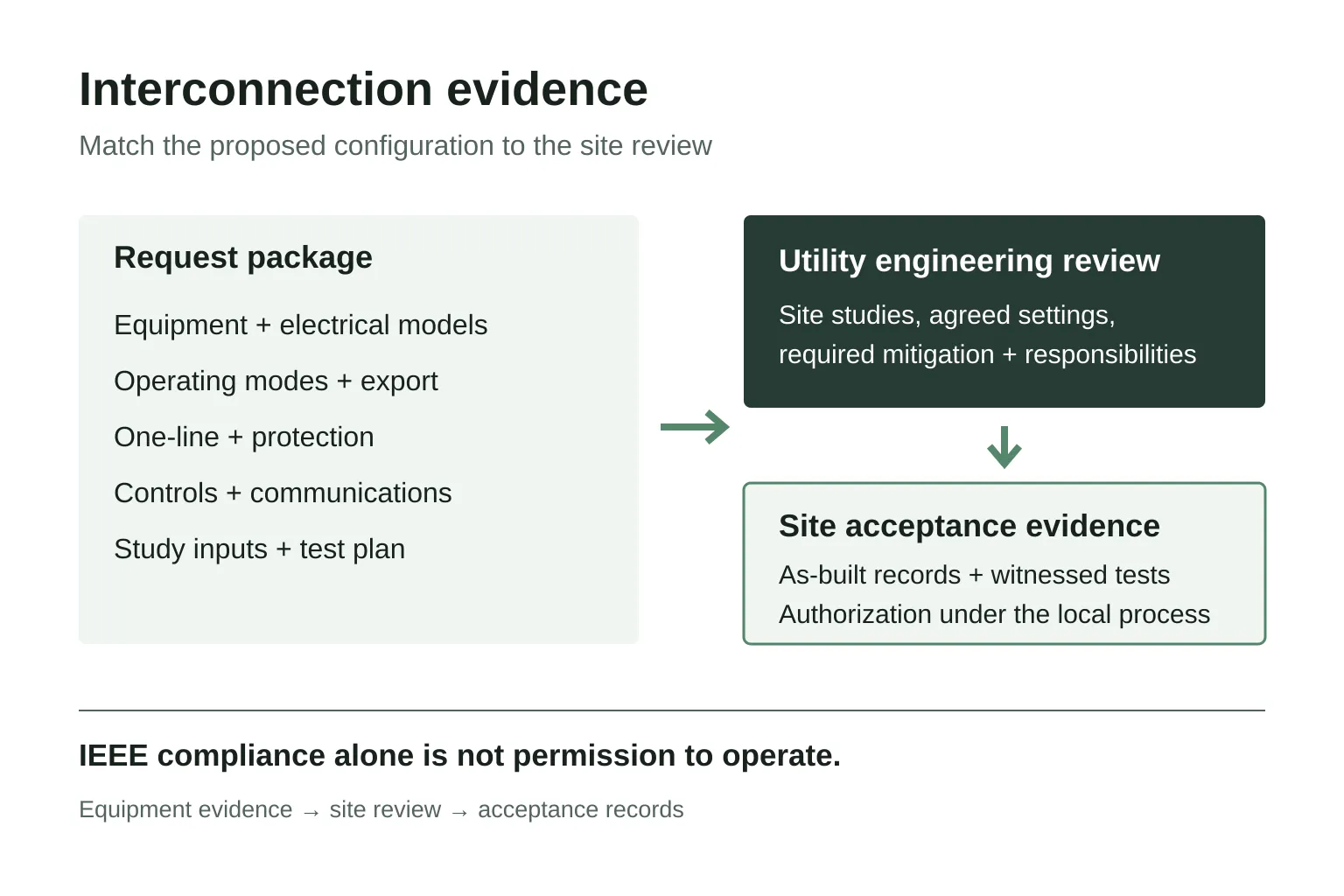
Distributed generation interconnection requirements are set by the applicable jurisdiction and serving utility’s tariff, procedures and technical rules. Before engineering review, request evidence identifying the exact equipment, electrical boundary, proposed operating modes, protection scheme, communications interfaces and study inputs. Plan a site-specific acceptance-test scope at the same time; completed commissioning records come later. IEEE compliance alone does not grant permission to operate: the serving utility’s review and project authorization process still govern.
Which distributed generation interconnection requirements apply?
Identify the serving utility, jurisdiction, applicable tariff or interconnection procedure, and current technical-requirements revision. Ask which standards editions, performance categories, settings and certification evidence apply to the proposed connection. Record the answer with its source and responsible utility contact rather than assuming a vendor’s default configuration is acceptable.
The National Laboratory of the Rockies’ clause-by-clause summary of IEEE 1547-2018 covers voltage and reactive-power control, abnormal-condition response, power quality, islanding, interoperability, and testing. Those technical capabilities require stakeholder coordination to select and apply settings. A standards summary is not a serving utility’s interconnection approval.
For a concrete utility example, Alliant Energy’s DER Technical Interconnection Requirements, effective December 1, 2025, requires application and agreement processes for covered parallel generation, review of protection schemes and relay settings, and commissioning-result submission before energization. Its inverter-settings section says study-specific settings supersede the document’s standard settings. These are Alliant requirements for its stated service context—not universal requirements for every utility.
Distributed generation interconnection evidence matrix
Use the matrix to issue a request to the developer, equipment supplier and engineering team. It is a suggested review package, to be aligned with the serving utility’s procedure. “Before review” means information needed to scope engineering work; “acceptance” means the records or demonstrations to plan now and obtain at the appropriate project stage.
| Area | Evidence to request and acceptance follow-through |
|---|---|
| Boundary | Before review: candidate connection point, voltage, site location, ownership boundary, one-line revision, existing generation and storage, and connected loads. Identify the point of common coupling and equipment connection points. Acceptance: as-built one-line, installed equipment identifiers and resolution of boundary changes. |
| Equipment | Before review: manufacturer, exact model, quantity, firmware and control version, kW/kVA ratings, transformer winding connections and impedance, grounding, fault-current characteristics and inrush data. Supply certificates and test reports applicable to that model and configuration; identify the validated network-model files and their assumptions. Acceptance: reconcile installed hardware, firmware and settings with the reviewed configuration; resolve substitutions. |
| Modes / export | Before review: proposed parallel, non-export or export-limited, intentional-island and reconnection modes; state which are requested and which are excluded. Define the export measurement point, limit, controller, command authority and response to loss of sensing or control. Acceptance: agreed mode/limit schedule and site tests demonstrating the accepted control functions. |
| Protection | Before review: relay and device models, proposed functions and settings, current/voltage transformer ratios, trip logic, interrupting ratings, grounding design, coordination assumptions, anti-islanding and reclosing interface. Identify whether transfer trip or other utility protection is needed. Acceptance: reviewed settings, calibration and trip-path reports, grounding evidence and required witnessed functional tests. |
| Controls | Before review: controller architecture, interface and protocol options, telemetry and command point list, measurement locations, communications ownership, access controls, time synchronization and behavior on communications loss. Separate dispatch and monitoring from protection communications. Acceptance: utility-agreed protocol and point mapping, end-to-end status/command checks, failure-response results and support responsibilities. |
| Studies | Before review: operating-case list, load and generation assumptions and available power-flow, voltage, fault, grounding and protection data. Ask the utility to identify required screening and studies, model formats and missing network inputs; flag possible thermal, reverse-flow, power-quality or stability questions. Acceptance: accepted study revisions and evidence that required mitigations are installed and reflected in settings and drawings. |
| Acceptance | Before review: draft commissioning test scope, pass/fail criteria, witness and hold points, accountable test agency, proposed report format and maintenance responsibilities. Acceptance: signed test results, as-left settings, resolved exceptions, required utility sign-off and authorization, plus the agreed periodic testing and change-review process. |
For every row, record document ID/revision, evidence status, open question, owner and required date. Keep vendor assertions, laboratory/type-test evidence, engineering study results and site commissioning results in separate fields. They answer different questions.
Use the interconnection evidence-request checklist guidance to turn the matrix into a request register. The blank checklist provides fields for document IDs and revisions, relevant findings, unresolved questions, and responsible owners with review dates across seven evidence categories. Download the four-page editable checklist (PDF) to record responses in a PDF reader that supports form fields, or print it for the review meeting.
Alliant’s Sections VIII–XI provide examples behind the protection, communications and acceptance rows: protection-scheme review, study-dependent communication paths, instrument-transformer checks, final relay-setting tests, trip checks, and remote-control/monitoring tests. Use the applicable utility’s requirements to determine the actual tests and sequence; this matrix does not prescribe live switching steps or relay settings.
Check whether equipment evidence matches the proposed configuration
A model name on a certificate is a starting point. Check the covered ratings, firmware or configuration restrictions, test standard and edition, issuing laboratory, and any conditions of use. If the supplier cannot show that the proposed equipment is covered, mark that evidence gap for utility review rather than treating a related product’s report as equivalent.
IEEE 1547 addresses interconnection and interoperability requirements; IEEE 1547.1 addresses conformance test procedures. Applicable certification and type-test evidence does not replace the study of the actual network connection or verification of installed settings. The laboratory’s summary of Clause 11 identifies manufacturers, testing and commissioning agencies, utility operators, owners and operators as distinct participants in testing and verification.
The same evidence discipline applies to inverter-based resources, rotating machines and mixed generation/storage configurations. The resource’s fuel or marketing label does not establish its electrical behavior at the connection point.
Resolve a mode mismatch before it enters the study
Consider a proposed industrial-site project that is described as non-exporting. Its request package contains an equipment certificate and a one-line, but does not identify where export is measured or what happens if the controller loses that measurement. A separate proposal also promises an intentional island during outages.
The reviewer can now issue three specific requests:
- Identify the export-control measurement point, control path and proposed failure response, with configuration-specific supporting evidence.
- Provide a mode schedule showing the island boundary, separation devices, voltage/frequency reference, transition assumptions and reconnection authority.
- Update the study-case list and acceptance-test scope to include each requested mode and the relevant control/protection failures.
The request package has exposed a design decision; it has not established that the project can operate as proposed. Non-export control does not itself establish islanding protection, and intentional-island operation needs its own coordinated scope. Approval for one mode should not be read as approval for every other mode.
Use the distribution-support reader to locate the candidate connection relative to the constrained feeder or substation. For the broader load, outage and operating-boundary decisions, read distributed generation microgrid planning.
Bring a defined connection question to the discussion
Resilient Power Works takes a technology-agnostic approach to evaluating generation options. Send your utility name, candidate site/connection point, proposed operating modes, export requirement and highest-priority evidence gap to resilient-power-works@brainer.one for a site-specific application discussion. Include the document revisions already available so the next conversation can focus on unresolved requirements.
Source references
- National Laboratory of the Rockies, Clause-by-Clause Summary of Requirements in IEEE Std 1547-2018, webpage last updated December 6, 2025: stakeholder roles and Clauses 4–11; a summary of the standard rather than its normative text.
- Alliant Energy, DER Technical Interconnection Requirements (PDF), effective December 1, 2025: Sections II–IV, VI, VIII–XI on process, equipment, protection, communications and commissioning. Utility-specific examples above are drawn from this guidance; confirm the requirements applicable to your project.