
Batteries vs Generators for Microgrid Resilience
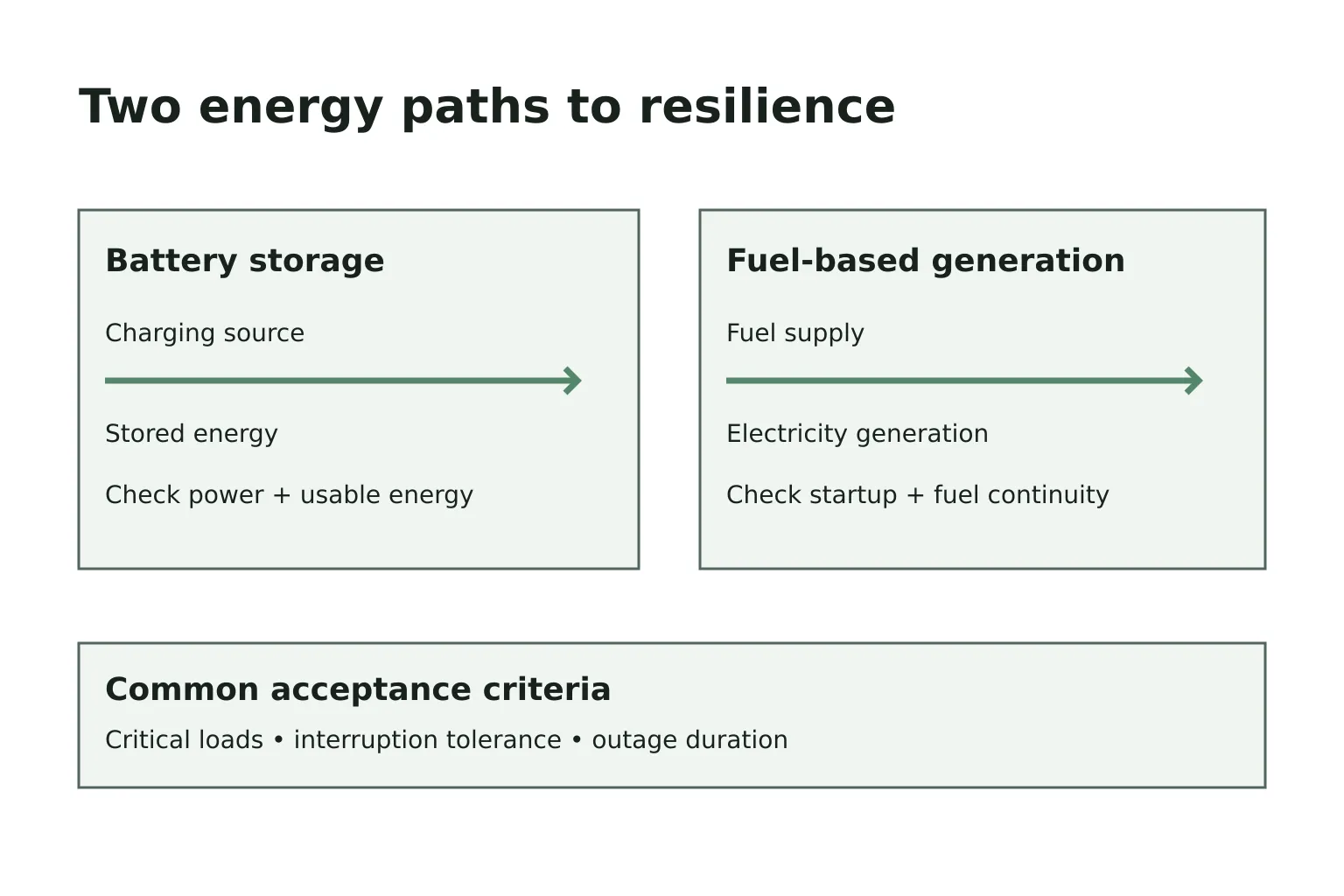
Batteries and dispatchable generation support grid resilience in different ways. Batteries store energy for later delivery; fuel-based dispatchable generation converts an available fuel supply into electricity on command, within its operating limits. For utilities comparing batteries versus generators for microgrid resilience, the right choice depends on load behavior, outage duration, energy replenishment and controls—not a universal technology ranking.
What roles do batteries and generators serve in a microgrid?
A battery energy storage system can support rapid changes in demand and bridge interruptions when its inverter, controls and switching arrangement are designed for that duty. Fuel-based generation can sustain electrical output while fuel and required auxiliaries remain available. Either resource can be part of an islanded microgrid, but the design must provide the needed voltage and frequency control.
“Dispatchable” does not mean unlimited output or instant availability. Both storage and generation have operating envelopes. For a battery, those include state of charge, discharge power and temperature limits. For a generator, they include start conditions, minimum output, ramping limits and fuel supply.
NREL’s Battery Storage for Resilience describes batteries used for power continuity and for balancing variable renewable generation. It also emphasizes critical loads and outage duration in selecting and sizing resilience resources.
Define the load-side duty before comparing resources
Load-side running power establishes the demand a resource must carry at each point in the outage; integrating that demand over time gives the outage energy to be delivered. Allowable interruption and pickup requirements establish how quickly service must resume and what starting or step demand the system must accommodate. Specify these inputs first so battery-only, generation-only and hybrid options are compared against the same service, rather than against equipment ratings that describe different duties.
If the load profile or outage duration is still uncertain, try the free outage-load calculator before comparing equipment. Vary the continuous load, concurrent added load and its duration, then extend the outage to see how running peak and load energy change. The calculator represents one constant load and one added-duty block; keep the ten-minute bridge and 48-hour endurance example below as separate service cases.
Follow the worked outage-input record to see how a time-varying load profile becomes a running-power and load-energy record, with interruption, pickup and supply evidence kept open for review. Then use the blank critical-load worksheet guidance to record your own site boundary, load priorities and interruption limits, followed by demand, pickup and outage-scenario inputs. Running power is not an approved source rating, and load energy is not a battery size or fuel requirement: losses, auxiliaries, reserves and configuration-specific transition and supply evidence still need evaluation.
Compare batteries and generators across five requirements
Battery energy storage
- Energy source: previously charged energy; replenishment requires a charging source.
- Response: established by the inverter, controls, switching and available state of charge.
- Endurance: limited by usable stored energy and charging opportunities.
- Island operation: check grid-forming capability where needed, reserve policy and protection.
- Lifecycle scope: charging energy, degradation, replacements and service.
Fuel-based dispatchable generation
- Energy source: fuel converted to electricity; endurance depends on usable fuel and supply continuity.
- Response: established by online state, start sequence, operating temperature, controls and ramp limits.
- Endurance: limited by fuel, auxiliaries, maintenance and operating limits.
- Island operation: check voltage/frequency control, startup support, load acceptance and protection.
- Lifecycle scope: fuel, consumables, maintenance, component replacement and service.
These are evaluation categories, not specifications for every battery chemistry or generator technology.
Separate continuity from long-duration energy
A process may need power within fractions of a second yet consume modest energy during a short interruption. Another may tolerate a brief restart but require sustained service for several days. Those duties should be specified separately.
For a design exercise, assume a 200 kW critical load must remain powered during a ten-minute generation startup. The load energy for the bridge is:
200 kW × 10/60 h = 33.3 kWh.
The bridge also requires at least 200 kW of deliverable power for that load. An engineering selection must account for starting or transient demand, conversion losses, reserve state of charge, temperature and end-of-life capability. A battery’s energy rating alone does not establish whether it can carry the transition.
If that same load must run for 48 hours, it requires 9.6 MWh at the load before losses. A battery-only approach would need enough usable energy or a dependable charging source through the outage. A fuel-based approach would need adequate fuel, supporting utilities and operational availability. The ten-minute bridge and the two-day endurance requirement are different sizing problems.
Stress-test replenishment instead of assuming it
For storage, examine state of charge when the outage begins. If the battery also performs peak management or other grid services, establish a reserve policy that protects the agreed resilience duty. Test the design with an outage starting at the lowest permitted reserve, not only with a fully charged battery.
For generation, examine both fuel inventory and replenishment. A pipeline connection is a supply arrangement, not proof that fuel delivery will continue through every event. On-site storage has a finite inventory, and delivery access can be impaired during severe weather.
For renewable-plus-storage systems, model the weather and season relevant to the outage scenario. Solar or wind can replenish storage and reduce fuel use, but an annual production total does not show whether energy is available during a particular outage.
NREL’s resilience guidance discusses both fuel-resupply constraints and the potential role of integrated renewables and storage. Translate those considerations into the site’s event model rather than assigning a generic number of backup hours to a technology.
Evaluate a hybrid when the duties divide naturally
A hybrid can assign fast transitions or short peaks to storage while generation carries sustained load and recharges the battery. That division can be useful when continuity and endurance requirements differ substantially.
It also adds coordination work. Define which resource establishes the island’s electrical reference, how the controller prioritizes loads, and when generation starts or changes output. Model charging demand together with the critical load so the generation resource is not inadvertently overloaded while restoring battery reserves.
NREL’s Power Couples: The Synergy Value of Battery-Generator Hybrids examines benefits from combining storage and generation. Those benefits depend on system design and duty cycle; pairing equipment does not automatically establish lower cost or higher resilience at every site.
Compare options using the same acceptance criteria
Use a common evaluation sheet for battery-only, generation-only and hybrid alternatives:
- Service delivered: loads, allowable interruption and outage duration.
- Starting condition: battery reserve, generator status and fuel inventory.
- Event conditions: renewable production, fuel access and water or auxiliary availability.
- Contingencies: resource trip, maintenance outage and communications failure.
- Measured acceptance: transition performance, load steps, load shedding and reconnection.
- Lifecycle scope: installed infrastructure, energy, maintenance, replacements and staffing.
Use the generation-options evaluation worksheet (PDF) to record two candidate configurations against the same site requirements. Read the worksheet guidance for how to define the shared requirements and record each option’s findings and sources before comparing the resource mix. Its Option A and Option B columns pair findings with their sources across net output, dispatch, outage duty, infrastructure, interconnection and support, helping identify evidence gaps before choosing a resource mix.
Specify emissions boundaries as carefully as electrical boundaries. Battery charging has an electricity source; fuel-based generation has both operating emissions and an upstream fuel pathway. Comparisons should use consistent boundaries and the same delivered service.
For the broader design sequence, see what to evaluate before adding distributed generation to a microgrid. For a configuration-specific checklist, see evaluating H2PWR Systems for a utility site.
Resilient Power Works approaches resource selection around the utility’s application. Its H2PWR Systems description presents an on-site-hydrogen hybrid generation concept intended for dispatchable and load-following duties; those intended roles should be assessed alongside storage and other generation using configuration-specific evidence.
Frame a site-specific resource comparison
Use the Utility Application Discussion handout (PDF) to summarize the duty that battery-only, generation-only and hybrid options must serve. Include your critical-load profile, interruption tolerance, outage duration and existing resource mix, with the charging or fuel-supply constraints that could limit endurance.
Send your utility name, site or location, and operating need with those inputs to resilient-power-works@brainer.one to discuss a comparison built around the same delivered service.
Source references
- NREL, Battery Storage for Resilience (2021): storage applications, critical-load sizing, outage duration and fuel-supply considerations.
- NREL, Power Couples: The Synergy Value of Battery-Generator Hybrids (2018): complementary storage and generation roles and system-dependent hybrid benefits.
- NREL, A Guide to Updating Interconnection Rules and Incorporating IEEE Standard 1547 (2021), intentional-island guidance: coordination of island operation and interconnection.
- Resilient Power Works, H2PWR Systems: RPW’s stated system concept and intended operating roles.