Distributed Generation as a Non-Wires Alternative
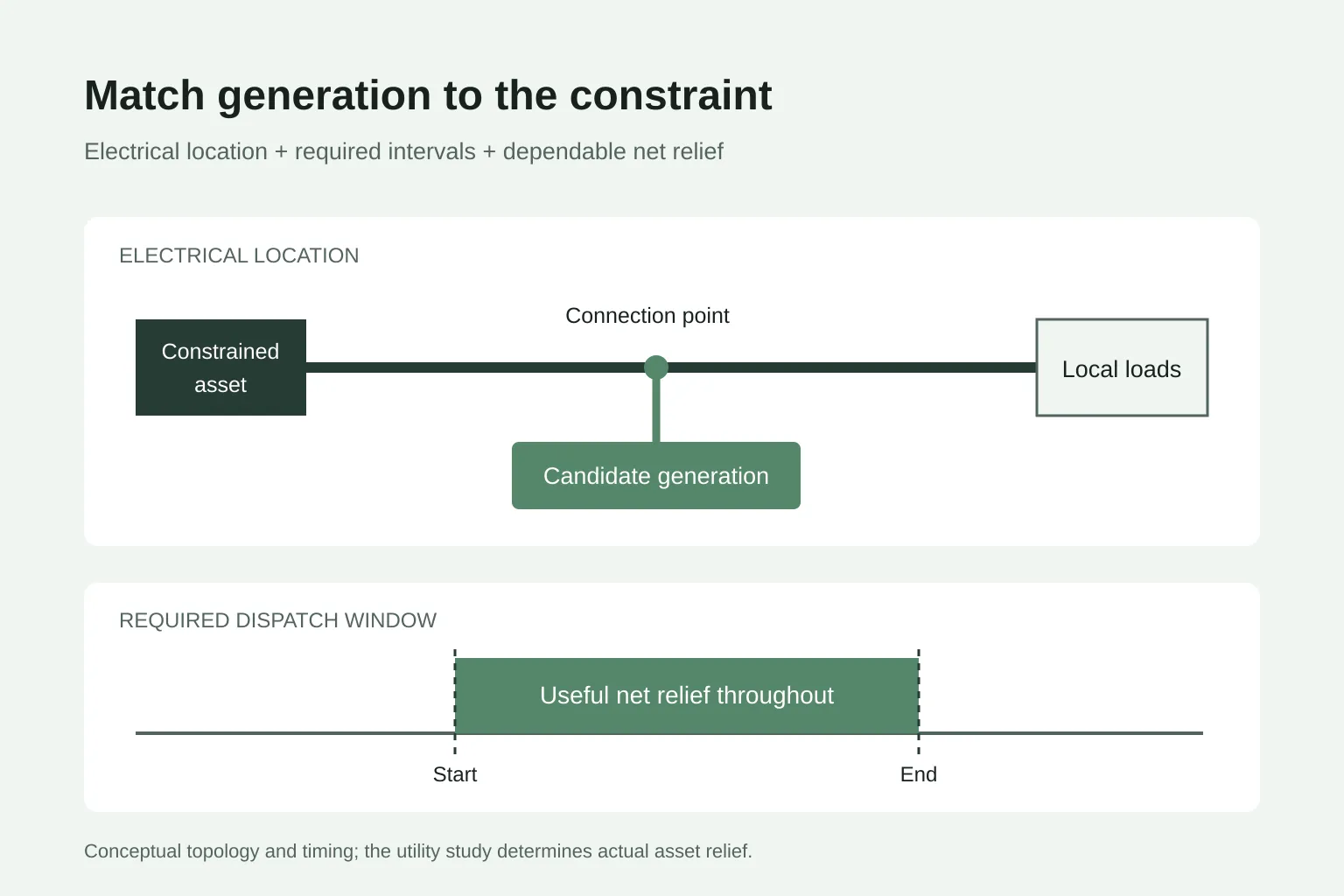
Distributed generation as a non-wires alternative must address a named distribution constraint at the right electrical location, with enough useful net contribution during every required interval. A candidate also needs credible availability, a utility-reviewed fallback for underperformance and comparable economic evidence. Local generation may warrant study, but nameplate capacity or proximity alone does not establish feasibility or upgrade deferral.
When can distributed generation be a non-wires alternative?
A non-wires alternative (NWA) is a utility-driven solution to an identified grid constraint that defers or eliminates a conventional system upgrade. Distributed generation can be considered for that role when its delivered response matches the utility's specific need; the resource remains a candidate until that match and the alternative comparison are demonstrated.
EPRI's August 2023 NWA research guide defines NWAs on page 1 and identifies resource availability, output variability, controllability, sustained response, reliability and lifetime as technology-adequacy considerations on page 6. The practical starting point is therefore a constraint record, not a preferred generator.
Name the constrained asset and electrical location
Identify the feeder segment, transformer or substation asset, its limiting criterion and the system condition that creates the need. For a thermal constraint, record the applicable rating and units, loading profile, forecast revision and whether the limit applies in normal operation or a specified contingency configuration.
Then locate the candidate connection point on the relevant one-line diagram. Generation on the load side of a constrained asset may reduce power flowing through it, but geographic closeness does not establish electrical usefulness. Circuit configuration, load distribution, reactive power and export limits can change the result. EPRI's guide specifically includes circuit configuration and network-constraint location among siting considerations on page 6.
Ask the utility study to map proposed net output at the connection point to relief at the named asset. If the constraint is expressed in amperes or kVA, a kW rating alone is not a complete comparison.
Turn the dated overload profile into a dispatch duty
“Summer peak support” is too broad to specify a resource. Record:
- Study years, relevant season or dates, start and end times, time zone and interval length.
- Required relief in each interval, duration per event, expected event frequency and consecutive-day exposure.
- Load-growth, weather and existing-resource assumptions, including sensitivity cases.
- The resource's required in-service date and the utility's decision deadline.
The resulting duty should specify notification and startup time, ramping, sustained net contribution, repeat calls and replenishment between events. Preserve the time-varying profile: equal daily energy does not mean equal relief during the limiting intervals.
Grid-connected overload relief and critical-load service during an outage are separate duties. If both are needed, define both rather than assuming a resilience resource also resolves the distribution constraint. The microgrid planning guide addresses electrical boundaries and outage-service requirements.
Compare useful net contribution, not nameplate capacity
Start with configuration-specific output under the required ambient and operating conditions. Deduct auxiliaries and other loads inside the stated measurement boundary, then apply the utility study's location-to-relief result. Keep output measured at generator terminals, net export at the connection point and relief at the constrained asset as distinct quantities.
Consider a planning exercise with these assumed inputs, not project results:
- Feeder F17's limiting segment needs 700 kW of relief, from 16:00 to 19:00 Eastern Daylight Time on July 19–23, 2027, in the forecast case being screened.
- A candidate connected on the load side is proposed to sustain 800 kW gross, with 80 kW of auxiliaries, giving 720 kW net at its connection point.
- For this simplified exercise, assume the screening model credits 90% of connection-point net output as relief at the limiting segment. An actual network study must determine that relationship; 90% is not a general planning factor.
Credited relief is 720 × 0.90 = 648 kW, leaving a 52 kW shortfall during each required interval. Over one three-hour event, the requested relief is 2.1 MWh, while credited relief is 1.944 MWh. Even uninterrupted delivery of the proposed output fails this assumed duty before availability or economics is considered.
The next action is to study a different configuration, a complementary resource or another alternative—not to credit the 800 kW nameplate as adequate capacity. Mark each input as measured, estimated, projected or planned, with its source and revision.
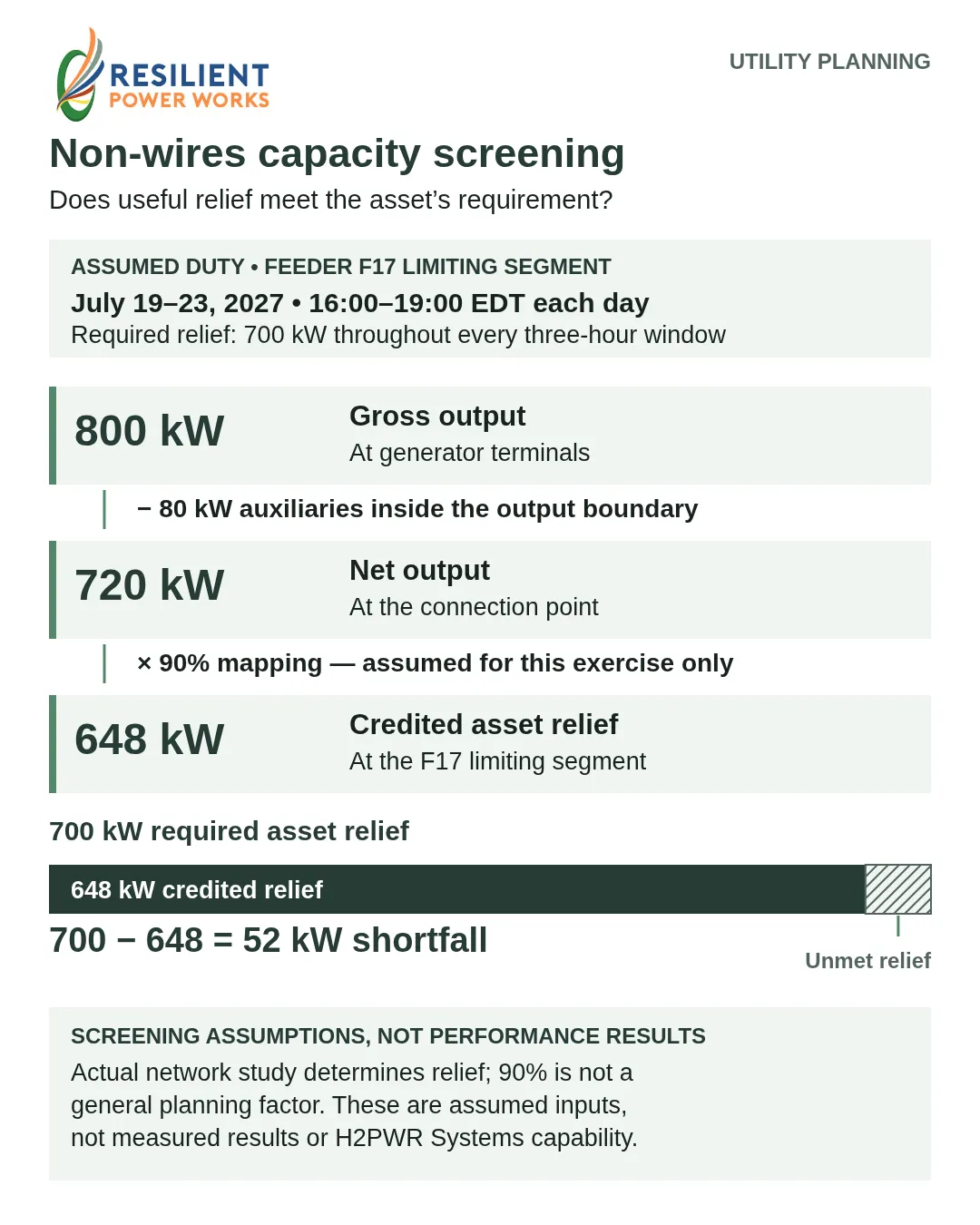
Gross output, connection-point net output and constrained-asset relief are different quantities; the hatched portion of the graphic shows the 52 kW unmet relief.
Download the non-wires capacity-shortfall graphic (PNG). Download the scalable non-wires capacity-shortfall graphic (SVG).
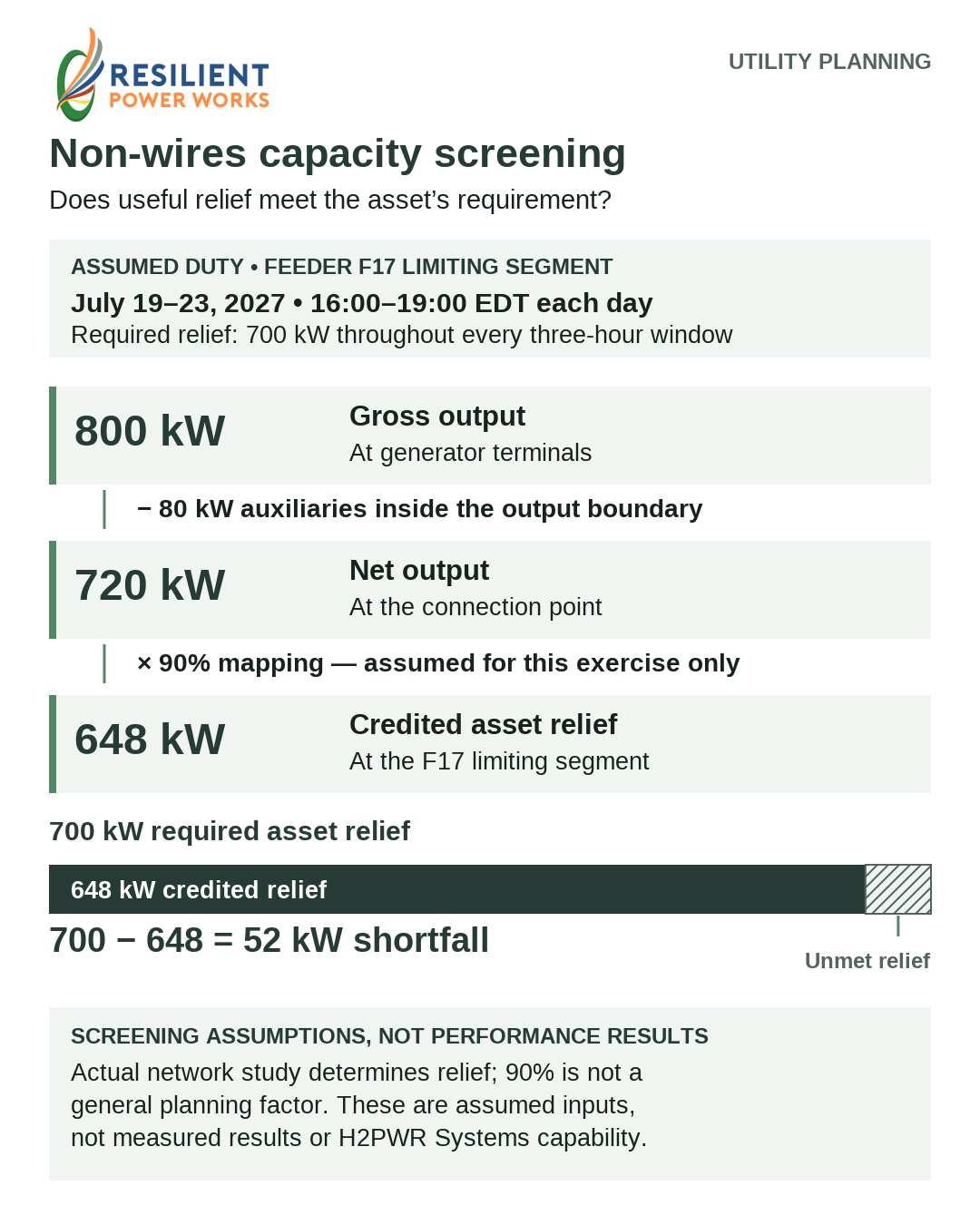
The graphic's screening quantities in text:
- Gross output: 800 kW at generator terminals.
- Auxiliary load: 80 kW deducted inside the stated output boundary.
- Connection-point net output: 800 − 80 = 720 kW.
- Asset-relief mapping: 90%, assumed only for this exercise, not a general planning factor.
- Credited relief at F17's limiting segment: 720 × 0.90 = 648 kW.
- Required asset relief: 700 kW in every required interval, from 16:00 to 19:00 Eastern Daylight Time (EDT) each day on July 19–23, 2027. The candidate is assumed to sustain its proposed output throughout each required three-hour window.
- Unmet relief: 700 − 648 = 52 kW shortfall.
Actual network study must determine the relationship between connection-point net output and constrained-asset relief. These are assumed inputs, not measured results or H2PWR Systems capability. Even uninterrupted delivery at the assumed level leaves this duty unmet; the result does not establish feasibility, upgrade deferral or savings.
Check availability during the actual need, then define fallback
Annual average availability does not by itself establish availability during the overload window. Request evidence for the required conditions and repeated duty, including:
- Ambient derating, planned maintenance, forced outages and resource degradation.
- Fuel or feedstock supply, water and auxiliary-service dependencies; for storage, usable inventory and recharge opportunities.
- Operating-hour and permit limits, dispatch authority, telemetry and performance verification.
- Dispatch priority when the same resource provides other services.
Test loss of a unit, communications, supply or dispatch response. Include common dependencies across portfolio members: adding units does not remove a shared supply risk.
For each underperformance case, record the unmet relief, affected asset exposure, proposed fallback, activation lead time, duration and responsible owner. The utility must evaluate whether the arrangement meets its planning criteria. EPRI discusses contingency planning for NWA underperformance on page 7; a contract remedy alone does not supply missing capacity.
Connection and export limits, protection, voltage and fault-duty impacts also need review. Use the distributed-generation interconnection requirements guide to frame that separate evidence request.
Compare economics against the same utility need
Use the named conventional upgrade as the baseline, alongside other credible options such as demand response, efficiency, storage, generation or a combined solution. Apply the same reliability criteria, study period, discount rate, price basis and forecast cases. EPRI's page 7 calls for a common evaluation standard and multi-year comparisons of traditional reinforcement against NWA alternatives.
Collect dated, project-specific evidence for:
- Baseline: upgrade scope, estimate source, in-service date, useful life and residual value.
- Candidate: equipment, interconnection, site and supply works, fuel or energy, operations and maintenance, controls, contracts, backup arrangements, replacements and removal.
- Timing: commissioning relative to the need-by date, possible deferral period to test, and any later upgrade still required.
- Sensitivity: load growth, resource life, supply prices, delivery risk and the cost of fallback.
Deferring an upgrade is not the same as avoiding its full capital cost. Compare expenditure timing and lifecycle consequences. Count other service benefits only where delivery is compatible with the primary constraint duty, and avoid double counting. EPRI's pages 6–7 discuss value stacking and priority conflicts between services.
Without a dated baseline estimate, candidate cost evidence and an adequate duty match, the economic result remains an open question.
Build the constraint-specific discussion record
Use the distribution constraint-to-duty worksheet guidance and download the four-page editable PDF to keep the utility-defined need, proposed resource duty and missing evidence separate. Record the asset and electrical location, dated overload profile, required net contribution, availability, fallback and comparable cost inputs. Assign each evidence gap an owner and review date.
Resilient Power Works takes a technology-agnostic approach to distributed-generation evaluation; H2PWR Systems may be one candidate, with configuration-specific duty and site fit evaluated against that record. Send your utility name, constrained asset or electrical location, dated overload window and evidence gaps to resilient-power-works@brainer.one to discuss the application. Use your utility-approved secure channel for sensitive network or customer information.
Source reference
EPRI, Integrating Non-Wires Alternatives into Utility Planning: 2023 EPRI Research Guide, August 2023, report 3002027412, especially pages 1 and 6–7. The guide provides the planning framework; the worked exercise above uses stated assumptions and does not report a utility project or validate a resource.